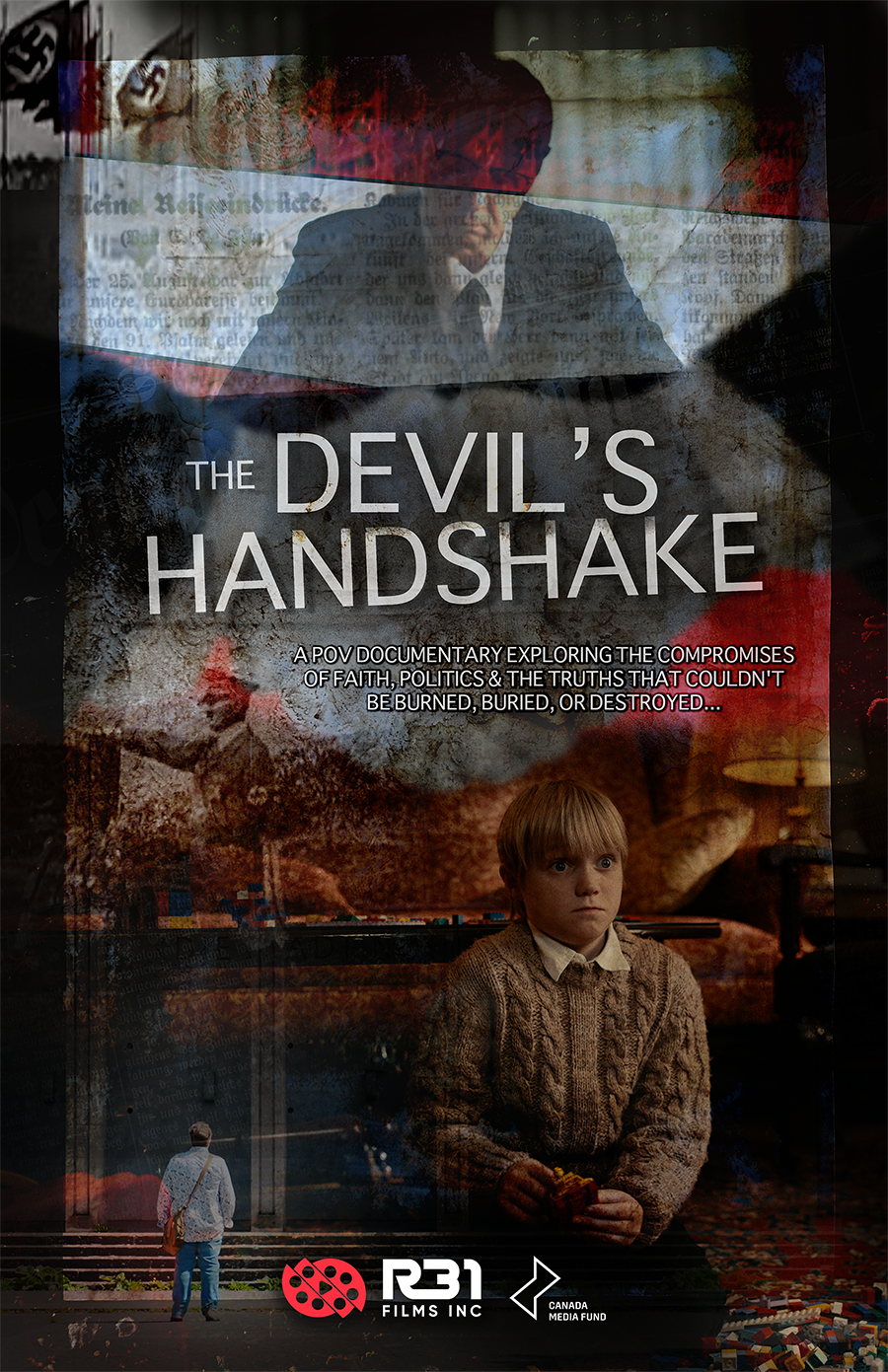
 What do you do when a creepy fun
project on a little Nazi episode in your hometown uncovers an
uncomfortable fact?
What do you do when a creepy fun
project on a little Nazi episode in your hometown uncovers an
uncomfortable fact?If you’re Andrew Wall of Refuge 31 films, you make it your next project!
Well, actually, about a decade and many other projects passed before Wall got to make this film about his great-grandfather’s Nazi episode. But the timing of the release of The Devil’s Handshake is perhaps exactly right for a film that asks what motivations, what history, what blinders lead us to support extremist movements that should be anathema to us.
In the talk-back after the screening at U of W, Wall and several audience members concluded the point was that you can’t judge folks in history because they have all kinds of reasons for why they do what they do.
But I don’t think that’s quite what Wall is doing. After all, he made the movie. It there was no valuation that something was off about what his great-grandfather supported, there would be no point to film.
All that excruciatingly slow moving suspense, illustrated by the same clips over and over again, toward the reveal we all knew was coming just wouldn’t have been needed at all if there weren’t some conclusion, some judgement, he was leading us toward.
Another audience member comment poked at that: “Why did you include all that history of the Mennonites at the beginning?”
Context, Wall said. Also for a non-Mennonite audience to understand. How we got here.
“Or how far we’ve departed from where we started,” the audience member rejoined.
He conceded a bit on that: I don’t see how someone raised a pacifist couldn’t see something wrong with the display of militarism in Nurnberg.
Well, I certainly didn’t learn the message of “don’t judge” from the film because I couldn’t help but think: Mennonites-who-are-supporting-certain-political-figures-right-now, this film is for you! Be careful which personalities and movements you hook your star to!
But historian Aileen Friesen expressed it well: It’s not that we don’t judge but that we must look at history from all angles so we can – with compassion – discuss and evaluate how things turned out. So people don’t get defensive and shut down conversations before you can learn anything. And maybe even – and if I weren’t already turning her words into my own interpretation, I certainly am now – be in a place where we can begin to judge that however understandable or not the factors that led them to that was place, the actions they took were still wrong.
It would be my dear hope that Mennonites – a people supposedly of great humility (of which we’re awfully proud), a people who love to explore and retell our history (“make up stories” as per venerable New Zealand-based anthropologist-historian authority on Russian Mennonites James Urry...who has definitely met my father) – could be exactly the people, especially at this moment in history, to exemplify this lesson: that we can know and appreciate our history, holding up its best version of itself without shirking away from confession about its darkest moments and thus allowing our repeated acknowledgement of our failures to keep informing our ongoing humility.
Mennonites have throughout history gotten awfully slippery on our pacifist commitments.
Mennonites have taken “church without spot or wrinkle” far too seriously and taken on supremacist attitudes when we should have seeking purity through repentance.
Mennonites have voted – figuratively and literally – for economic interests purportedly for the best for the community, as though we don’t know that no matter how much you bow and simp to the economy's whims, it will punch you in the face when it feels like it. (To vote "for the sake of the economy" over morality is to fail to understand your Christian duty.)
Mennonites have also hidden behind HR policies and a lot of “we didn’t know”s when the ways our supposed peacemaking behaviour has deeply wronged someone else comes to light.
I’m sure there’s plenty more: those are the most available at this moment.
The most deeply troubling part of the documentary was not that a well-known philanthropist in both the spheres of my civic and religious community had a period of being deeply sympathetic with the Nazis. No, it was one sentence within an anecdote.
Great-grandpa’s memoir contained several cryptic sentences expressing some regret for misguided allegiances. But great-grandpa’s file in the archives (he was a successful businessman and church leader) had gaps. It has grown thinner after a certain church leader visited the archives, spent time in the fonds, and left, having righted history.
That is the blackest mark of them all.
Making poor judgement calls in the complex mix of family suffering plus propaganda can be understood, maybe even excused.
Lacking the courage to confess and repent, thus avoiding the subject entirely is also understandable, albeit cowardly.
But having enough shame to recognize the error adn choosing to instead try to make it disappear is inexcusable.
The truth will out.
It is probably inevitable that each one of us will at some point make an agreement with the devil. What we do afterward probably says more about our integrity than the details of the handshake.
Kudos to the filmmaker for open-handedly exploring the picture and holding up a mirror to question the implications of the company we keep.
Comments